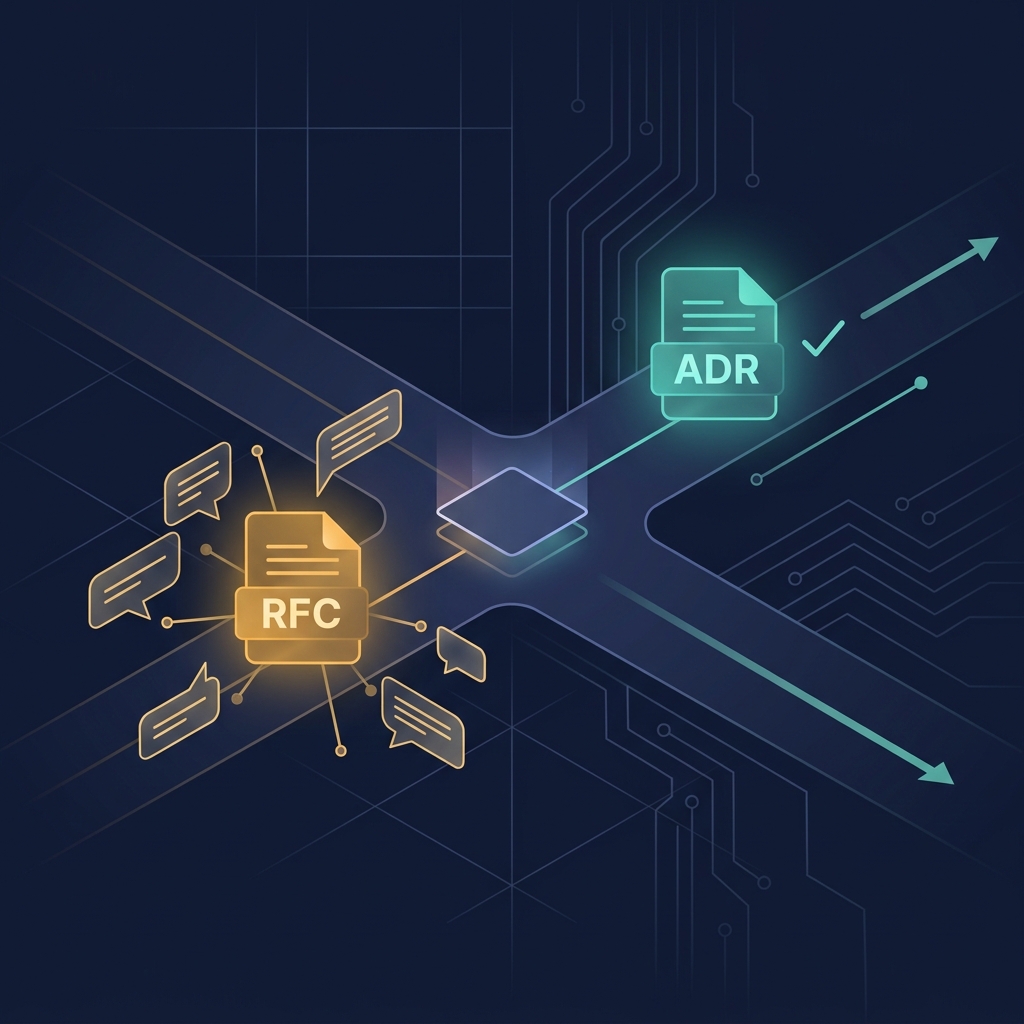
RFCs vs ADRs: Which One Should You Actually Write?
The Documentation Trap Nobody Talks About
Every engineering team I've worked with has had the same argument: "Should we write an RFC or an ADR?" The answer is almost always wrong — because the question itself is wrong. RFCs and ADRs solve fundamentally different problems. Treating them as interchangeable is like using a debugger when you need a profiler. Both involve staring at code, but the outcomes are entirely different.
After authoring 40+ engineering standards across enterprise client engagements and building a fintech platform that scaled to 400k users, I've landed on a hard rule: the document type should match the decision's blast radius, not your team's habit. A small team shipping fast needs lightweight ADRs. A cross-functional platform migration demands an RFC. Forcing everything into one format either slows you down or leaves critical decisions undocumented.
What an ADR Actually Is (And Isn't)
An Architecture Decision Record captures a single decision with its context, options considered, and the rationale behind the chosen path. It's a point-in-time snapshot — not a proposal, not a discussion thread. The decision is already made.
Here's the ADR template I use across teams:
# ADR-0042: Use Redis for Session Storage

## Status
Accepted

## Context
Our Node.js services store sessions in-memory, causing data loss
on container restarts. ECS task recycling drops ~2% of active sessions
during deployments. We need a shared, persistent session store.

## Decision
Adopt Redis (ElastiCache) for session storage across all services.

## Consequences
- Sessions survive container restarts and blue-green deployments
- Adds Redis as an infrastructure dependency (~$45/month)
- Requires session serialization — no complex objects in session state
- Team must learn Redis connection pooling patterns
Notice what's missing: there's no "Alternatives Analysis" section spanning three pages. No stakeholder sign-off matrix. The ADR records what was decided and why, in under a hundred words. When I was leading a team of eight engineers at a fintech startup, we shipped ADRs as markdown files committed alongside the code they affected. A developer six months later could open docs/adr/ and understand every architectural pivot without excavating Slack threads.
What an RFC Is For
A Request for Comments is a proposal — it invites feedback before a decision is made. RFCs are collaborative documents designed to surface risks, gather cross-team input, and build consensus on changes with wide blast radius.
When I led the migration from a monolithic MVP to a microservices architecture, we wrote an RFC before touching a single line of code. The migration affected authentication, data pipelines, deployment infrastructure, and billing. An ADR would have been absurd — the decision hadn't been made yet, and we needed input from backend engineers, the QA team, and our DevOps pipeline owners.
Here's the skeleton I use for RFCs:
# RFC: Migrate Authentication to Standalone Microservice

## Summary
Extract auth logic from the monolith into a dedicated service behind
an API gateway, enabling independent scaling and deployment.

## Motivation
Current auth is coupled to the monolith's deploy cycle. A single
auth bug forces a full platform redeploy (~18 min). Decoupling
reduces auth deploy time to ~3 min and isolates blast radius.

## Proposed Design
- Standalone Node.js service with Redis-backed token store
- JWT validation middleware shared via internal npm package
- Migration: dual-write phase (4 weeks), then cutover

## Open Questions
1. Do we migrate existing sessions or force re-login?
2. Rate limiting at gateway vs service level?

## Alternatives Considered
- API gateway auth only (rejected: insufficient audit logging)
- Third-party auth provider (rejected: data residency concerns)
The RFC format deliberately includes Open Questions — because the entire point is to get answers before committing. I've seen teams write "RFCs" that are actually just long ADRs with a fancier title. If there are no open questions and no feedback loop, you don't have an RFC. You have a memo.
The 3-Question Decision Framework
After years of managing concurrent engineering workstreams and writing documentation that teams actually read, I use three questions to decide which format fits:
- Is the decision already made? → Write an ADR.
- Does this change cross team or service boundaries? → Write an RFC.
- Can the decision be reversed in under a day? → Consider skipping both — a code comment or commit message might be enough.
This framework saved us from two failure modes I'd seen repeatedly. At a real estate tech company, we over-documented: every database index change got an ADR. The docs/ folder became a graveyard nobody searched. At an early-stage startup, we under-documented: critical auth decisions lived in a Slack thread that auto-deleted after ninety days.
The sweet spot: ADRs for decisions that would confuse a new hire. RFCs for decisions that could break another team's sprint.
Encoding the Framework in Your Repository
Documentation that lives outside the codebase dies. I embed both formats directly in the repo using a simple convention:
project-root/
├── docs/
│   ├── adr/
│   │   ├── 0001-use-typescript-strict-mode.md
│   │   ├── 0002-adopt-redis-for-caching.md
│   │   └── template.md
│   └── rfc/
│       ├── 001-migrate-to-microservices.md
│       ├── 002-event-driven-notifications.md
│       └── template.md
ADRs are numbered sequentially and immutable — you never edit an old ADR, you supersede it with a new one. RFCs have a lifecycle: Draft → Under Review → Accepted/Rejected → Superseded. When managing CI/CD pipelines, I added a pre-commit hook that validates ADR formatting:
// scripts/validate-adrs.js
const fs = require('fs');
const path = require('path');

const ADR_DIR = path.join(__dirname, '..', 'docs', 'adr');
const REQUIRED_SECTIONS = ['## Status', '## Context', '## Decision', '## Consequences'];

const files = fs.readdirSync(ADR_DIR).filter(f => f.endsWith('.md') && f !== 'template.md');

let failures = 0;
files.forEach(file => {
  const content = fs.readFileSync(path.join(ADR_DIR, file), 'utf-8');
  const missing = REQUIRED_SECTIONS.filter(s => !content.includes(s));
  if (missing.length > 0) {
    console.error(`${file}: missing sections: ${missing.join(', ')}`);
    failures++;
  }
});

process.exit(failures > 0 ? 1 : 0);
This catches malformed ADRs before they land in main. It takes five minutes to set up and prevents the slow decay of documentation quality that plagues every team I've worked with.
When to Skip Both
Not every decision needs a document. When I was building internal tools and delivery management systems early in my career, we wasted hours documenting choices that were trivially reversible. Choosing between dayjs and date-fns? That's a commit message, not an ADR. Picking a CSS naming convention for a single component? A code comment.
The threshold I use: if reversing the decision takes less effort than writing the document, skip the document. Save your team's writing energy for decisions that actually compound — database choices, API contracts, authentication flows, and service boundaries.
Making It Stick: Review Cadence
Documentation rots without maintenance. Every quarter, I schedule a thirty-minute "ADR audit" where the team scans the docs/adr/ directory and marks stale records as Superseded. For RFCs, we review open proposals bi-weekly during sprint planning. This cadence prevents the two most common documentation deaths: the ghost town (nobody reads it) and the museum (everything is outdated but preserved).
At my current role managing three concurrent workstreams, this practice keeps architectural context alive across teams. A new engineer onboarding can read the last ten ADRs and understand six months of technical evolution in under an hour.
Key Takeaways
Choosing between RFCs and ADRs is not a religious debate — it's a sizing exercise. Here's the framework distilled:
-
ADRs record decisions already made. Keep them short, immutable, and co-located with code. If a new hire would ask "why did we do this?" — write an ADR.
-
RFCs propose changes that need feedback. Use them for cross-team or high-blast-radius decisions. If there are no open questions, it's not an RFC.
-
Use the 3-question test: Decision made? ADR. Crosses boundaries? RFC. Reversible in a day? Skip both.
-
Embed documentation in the repo, enforce structure with automation, and audit quarterly. Documentation that lives in Confluence dies in Confluence.
-
Protect your team's writing energy. Over-documentation kills adoption just as surely as under-documentation kills knowledge. Match the document's weight to the decision's gravity.

Himanshu Shrivastava
Senior Full Stack Engineer · Node.js · React · TypeScript · AWS · Accessibility