The 3 Code Smells Even Advanced AI Misses Every Time (Why Human Staff Engineers Still Win)
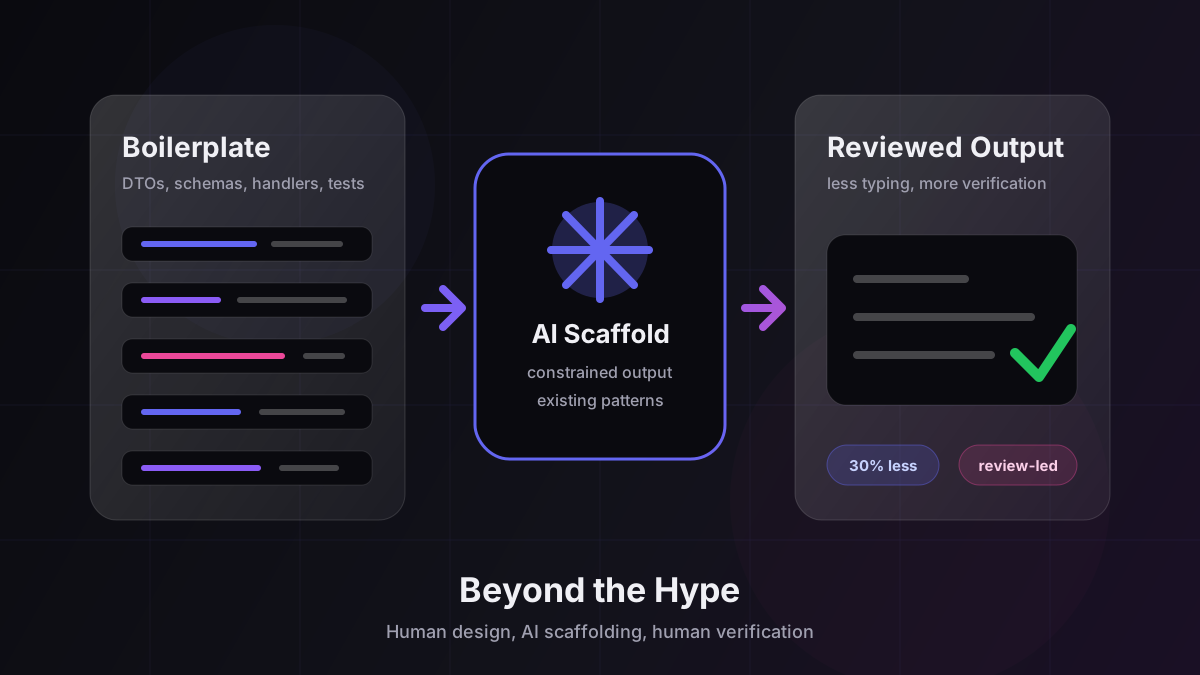
I reduced boilerplate development time by 30% when I integrated AI coding assistants into my engineering workflow last year. The productivity gains were real—refactoring became faster, repetitive patterns disappeared, and junior engineers wrote better code with AI assistance.
But then I noticed something strange during code reviews.
AI-generated code would pass all linters, compile without warnings, and even pass unit tests. Yet during production deployments, subtle bugs would surface—logic that worked but didn't fit, error handling that looked clean but created silent failures, abstractions that over-engineered simple requirements.
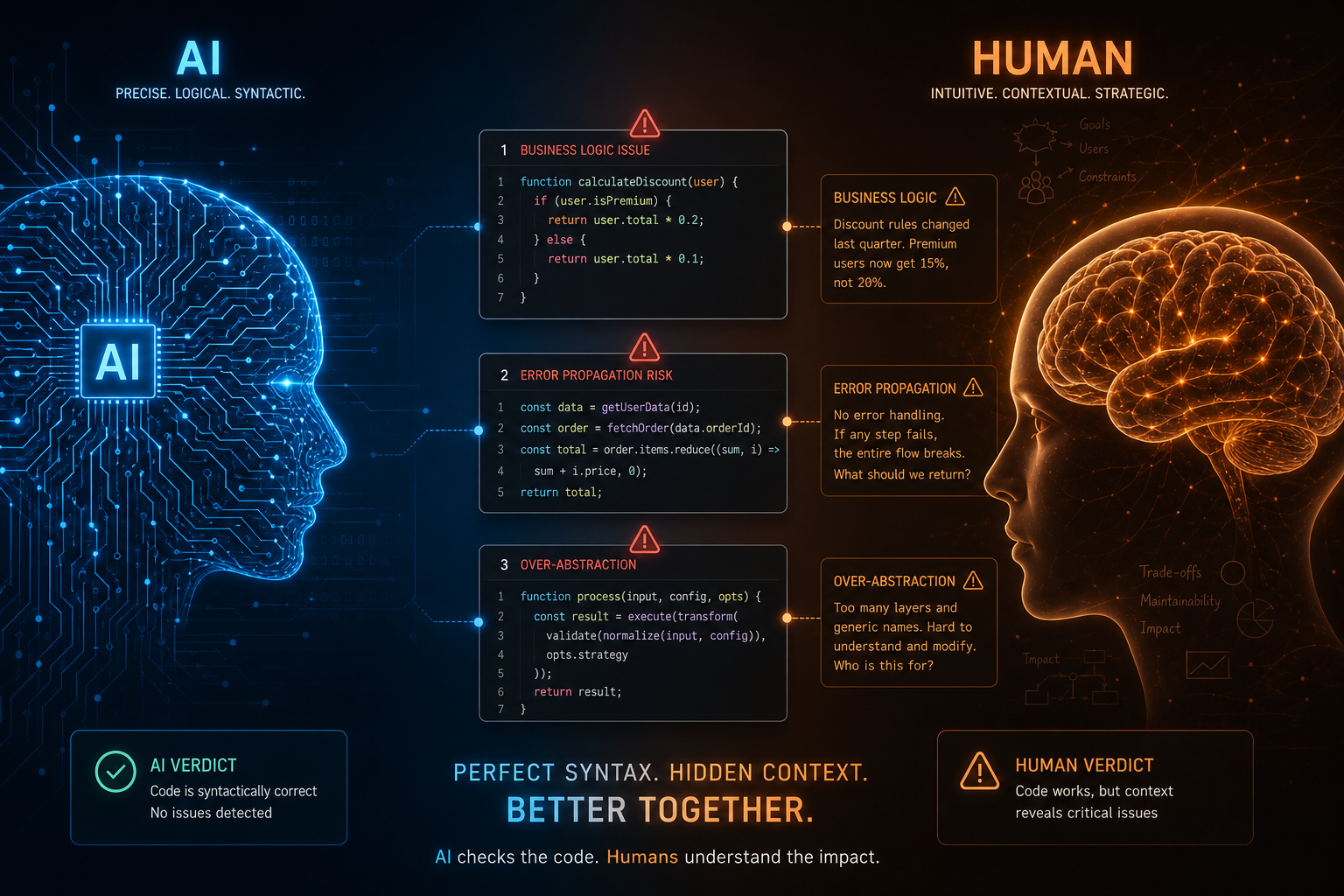
After reviewing hundreds of AI-assisted pull requests across multiple concurrent workstreams, I've identified three code smells that advanced AI coding assistants consistently miss. These aren't syntax errors or anti-patterns—they're deeper issues that require business context, system intuition, and architectural judgment.
1. Business Logic Drift: When Code Works But Doesn't Belong
The most insidious AI-generated code smell is business logic drift—code that compiles, passes tests, and looks reasonable, but violates domain-specific invariants that only humans who understand the business can catch.
Here's a real example from an agentic CI/CD workflow I built. The AI suggested this payment status update:
async function processRefund(orderId: string, amount: number) {
  const order = await getOrder(orderId);

  if (order.status === 'paid') {
    await refundPayment(order.paymentId, amount);
    await updateOrderStatus(orderId, 'refunded');
    return { success: true };
  }

  throw new Error('Order must be paid to process refund');
}
This looks fine. It checks if the order is paid, processes the refund, updates the status. But in a production payment system serving 400K+ users, this violated a critical business rule: orders should transition to refund_pending first, not directly to refunded, because payment providers typically take 3-5 business days to settle.
The correct implementation required understanding the payment state machine:
async function processRefund(orderId: string, amount: number) {
  const order = await getOrder(orderId);

  // Business rule: refunds must go through pending state
  if (order.status !== 'paid') {
    throw new Error('Order must be paid to process refund');
  }

  if (order.hasActiveDispute) {
    throw new Error('Cannot refund order with active dispute');
  }

  await initiateRefund(order.paymentId, amount);
  await updateOrderStatus(orderId, 'refund_pending');

  // Actual status change to 'refunded' happens via webhook
  return { success: true, pendingCompletion: true };
}
AI assistants suggest code based on patterns they've seen, but they can't know that payment provider webhooks will handle the final status transition, or that a domain might have a hasActiveDispute flag that blocks refunds.
The fix: During code review, I now specifically ask: "Does this logic align with the business rules?" Not "does this compile?" but "does this belong here?"
2. Error Cascading Blindspots: Clean Syntax, Silent Failures
AI coding assistants love suggesting try-catch blocks and error handling. The problem? They optimize for catching errors, not surfacing them meaningfully.
When I implemented a 3-layer observability stack for a production system, I found dozens of AI-suggested error handlers that looked like this:
async function syncUserData(userId: string) {
  try {
    const userData = await fetchFromPrimaryDB(userId);
    await updateCache(userId, userData);
    await notifyDownstreamServices(userId);
    return userData;
  } catch (error) {
    console.error('Error syncing user data:', error);
    return null;
  }
}
This is catastrophically bad in production. The function swallows errors and returns null, which downstream callers might interpret as "user not found" rather than "sync failed." Monitoring systems wouldn't alert, logs would be buried, and you'd have silent data inconsistencies.
Here's what human engineers write:
async function syncUserData(userId: string): Promise<UserData> {
  try {
    const userData = await fetchFromPrimaryDB(userId);
    await updateCache(userId, userData);
    await notifyDownstreamServices(userId);
    return userData;
  } catch (error) {
    // Log with structured context for observability
    logger.error('User data sync failed', {
      userId,
      error: error.message,
      stack: error.stack,
      operation: 'syncUserData'
    });

    // Re-throw with context for upstream handlers
    throw new DataSyncError(
      `Failed to sync user ${userId}`,
      { cause: error, userId }
    );
  }
}
The difference: the code propagates errors up with context, logs structured data for observability stacks, and forces upstream callers to handle failure explicitly.
This pattern cut Mean Time to Resolution (MTTR) by 35% because engineers could trace failures across service boundaries instead of debugging silent nulls.
The fix: In PR reviews, I reject any error handler that returns null, undefined, or a default value without explicit justification. Errors should bubble up unless you have a specific recovery strategy.
3. Premature Abstraction Debt: When "Clean Code" Becomes Over-Engineering
AI assistants have been trained on millions of repositories where experienced engineers write abstractions, factories, and design patterns. The problem? AI doesn't know when not to abstract.
When I shifted accessibility checks left in a CI/CD pipeline, an AI pair-programmer suggested this for the ESLint accessibility rule configuration:
// AI suggestion: "Clean" abstraction
class AccessibilityRuleConfigFactory {
  private rules: Map<string, RuleConfig> = new Map();

  constructor(private severity: 'error' | 'warn') {}

  addRule(name: string, config: RuleConfig) {
    this.rules.set(name, { ...config, severity: this.severity });
    return this;
  }

  build(): Record<string, RuleConfig> {
    return Object.fromEntries(this.rules);
  }
}

const a11yConfig = new AccessibilityRuleConfigFactory('error')
  .addRule('jsx-a11y/alt-text', { enabled: true })
  .addRule('jsx-a11y/aria-props', { enabled: true })
  .build();
This is over-engineered for a configuration file that changes once per quarter. What was actually needed:
// Human solution: Direct and maintainable
const a11yConfig = {
  'jsx-a11y/alt-text': 'error',
  'jsx-a11y/aria-props': 'error',
  'jsx-a11y/aria-proptypes': 'error',
  'jsx-a11y/aria-unsupported-elements': 'error',
  'jsx-a11y/role-has-required-aria-props': 'error'
};
The AI created a factory pattern for data that's essentially static. This added complexity—more code to test, more cognitive load for the next engineer—without providing flexibility anyone would actually use.
The fix: I now apply the "three-instance rule"—don't abstract until you have three real use cases. If AI suggests a pattern for a single use case, push back. YAGNI (You Aren't Gonna Need It) beats "clean code" abstractions every time.
Why Human Engineers Still Win
After integrating AI coding assistants into engineering workflows and building agentic CI/CD systems, I'm convinced that AI is a powerful amplifier—but not a replacement.
The three code smells above share a common thread: they require context beyond the codebase. Business domain knowledge, system-wide architectural intuition, and judgment about when not to code something.
AI can write syntactically correct code at incredible speed. But it can't tell you that payment providers require pending states, that observability stacks need structured error context, or that configuration files don't need factory patterns.
That gap is where staff engineers add value—not in typing speed, but in knowing what to build and when to stop building.
Key Takeaways
-
Business Logic Drift: AI suggests code based on patterns, not domain rules. Always ask: "Does this logic align with the business requirements?"
-
Error Cascading Blindspots: AI optimizes for catching errors, not surfacing them. Reject error handlers that swallow failures or return default values without explicit recovery strategies.
-
Premature Abstraction Debt: AI over-abstracts because it's trained on mature codebases. Apply the three-instance rule—don't abstract until you have three real use cases.
-
Context is the moat: The most valuable skill in the AI-assisted era isn't writing code—it's knowing which code not to write and understanding the business context that makes code correct beyond syntax.
-
Code review is your defense: Implement PR review checklists that explicitly check for these three smells. Teams can save 6+ hours weekly by catching these issues before they hit production.

Himanshu Shrivastava
Senior Full Stack Engineer · Node.js · React · TypeScript · AWS · Accessibility