5 Questions Before Merging Agent PRs
The Merge Button Is the Last Line of Defense
Last quarter, our agentic CI/CD pipeline generated over 200 pull requests across three active workstreams. Feature scaffolds, test suites, refactors — all appearing in my review queue before I'd finished my morning coffee.
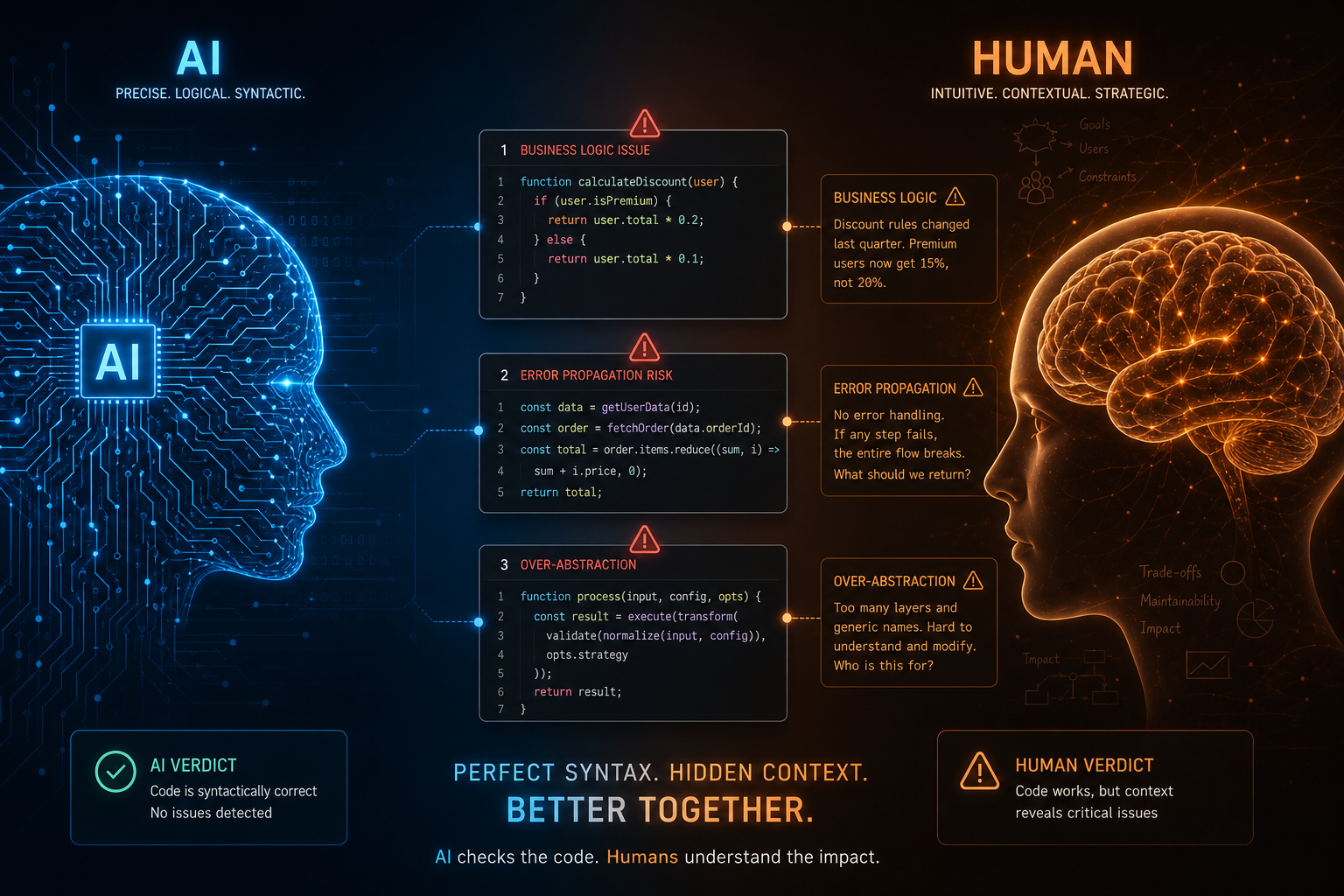
When I first integrated agentic workflows at an enterprise engagement, I made the mistake most teams make: I treated agent PRs like human PRs. Same review checklist, same gut-feel approval. Within two weeks, we'd merged a refactor that silently broke our accessibility compliance — something no lint rule caught because the agent had technically followed every pattern while missing the intent entirely.
That experience forced me to develop a structured review framework. These are the 5 questions I now ask before every agent-generated PR gets merged.
Question 1: Did the Agent Solve the Right Problem?
Agents are exceptional at following instructions. They're terrible at questioning them. A vague prompt like "improve performance" can produce a PR that aggressively caches queries — including ones that must return fresh data.
Before reviewing a single line, I check prompt-to-diff alignment:
# agent-task.yml — what we asked
task: "Reduce API response time for /api/v2/transactions"
scope: "query optimization only"
constraints:
  - do not modify caching layer
  - preserve existing pagination behavior

# What the agent PR actually touched:
# ✅ src/services/transactionQuery.ts — index hints added
# ❌ src/middleware/cache.ts — TTL modified (out of scope)
# ❌ src/routes/transactions.ts — pagination limit changed
Two of those three files violate the scope constraint. The first question isn't "is this code correct?" — it's "is this code relevant?"
Question 2: What Did It Change That It Wasn't Asked To?
Agents have a tendency to "helpfully" refactor adjacent code. I call these drift mutations: changes that are technically improvements but weren't requested.
I run a scope-check script in CI:
#!/bin/bash
# scope-check.sh — flag files outside the agent's declared scope
ALLOWED_PATHS=$(cat .agent-scope.json | jq -r '.allowed[]')
CHANGED_FILES=$(git diff --name-only origin/main...HEAD)

for file in $CHANGED_FILES; do
  match=false
  for pattern in $ALLOWED_PATHS; do
    [[ "$file" == $pattern* ]] && match=true && break
  done
  [ "$match" = false ] && echo "⚠️  OUT OF SCOPE: $file"
done
This catches about 30% of agent PRs that include unauthorized changes — renamed variables in shared utilities, updated imports in unrelated modules, or "cleaned up" comments that actually contained critical context.
Question 3: Does It Understand the Boundaries It Can't See?
Agents don't understand organizational boundaries — the handshake agreements between teams, the implicit contracts in shared APIs, the "don't touch this, it's load-bearing" tribal knowledge.
At a fintech startup I co-founded, we had a payment reconciliation service with a seemingly redundant error-handling pattern. Any agent would refactor it. But that pattern existed because a third-party processor occasionally sent duplicate webhooks, and our retry logic depended on that exact shape.
I now maintain a .agent-boundaries.md in every repository:
# Agent Boundaries

## Do Not Modify
- `src/payments/reconciliation.ts` — custom retry logic for vendor edge cases
- `src/auth/legacy-session.ts` — migration in progress, frozen until Q3

## Requires Human Review
- Any changes to `src/shared/` — cross-team dependencies
- Database migration files — requires DBA sign-off
This file is referenced in the agent's system prompt and enforced in CI. Not bulletproof, but it eliminates the most dangerous category of blind changes.
Question 4: Can I Reproduce the Reasoning?
Human developers explain why they made a choice. Agents can't — at least not reliably. I require every agent PR to include a decision log:
Agent Decision Log:
- Chose
MapoverObjectfor session storage because key deletion frequency exceeds 1000/min- Skipped index on
created_atbecause table has fewer than 10k rows; index overhead exceeds query savings- Used
Promise.allSettledinstead ofPromise.allto prevent partial failures from masking successes
If the decision log is missing, shallow, or contradicts the implementation, the PR goes back. This ensures that when the next engineer modifies this code six months later, the intent is preserved alongside the implementation.
Question 5: What Happens When This Breaks at 3 AM?
Every PR should answer: when this fails in production, will the on-call engineer diagnose it?
Agent-generated code often has excellent happy-path coverage and abysmal failure-mode visibility. I've seen agent PRs with comprehensive edge-case tests that logged errors as "Operation failed" — completely useless during a 3 AM incident.
My operability checklist:
- Error messages: Enough context to diagnose without reading source?
- Observability: Structured logs at key decision points?
- Degradation: Fails open or closed — and is that right for this context?
- Rollback safety: Revertible without migrations or data backfills?
Having driven our team's MTTR down by 35% through better incident practices, I can tell you: a missing log line at 3 AM costs orders of magnitude more than adding it during review.
Key Takeaways
Agent PRs aren't inherently riskier than human PRs — but they fail in different ways. They're confident, fast, and utterly unconcerned with organizational context.
The framework, distilled:
- Prompt-to-diff alignment — Did it solve what you actually asked?
- Scope containment — Did it change things it shouldn't have?
- Boundary awareness — Does it respect contracts it can't see?
- Reproducible reasoning — Can you trace why, not just what?
- Operability under failure — Will this be debuggable at 3 AM?
These five questions aren't overhead — they're the difference between leveraging AI at scale and shipping technical debt at superhuman speed.

Himanshu Shrivastava
Senior Full Stack Engineer · Node.js · React · TypeScript · AWS · Accessibility