How I Save 6 Hours Per Engineer Weekly with Agentic CI/CD Workflows
The best line of code is the one an AI writes for you, reviews for you, and deploys for you.
I've been working at the intersection of AI tooling and software engineering for the past year, and I've found that the highest-leverage AI investment isn't writing code faster — it's eliminating manual overhead in the review and delivery pipeline.
Here's the agentic workflow setup I've built that saves my team 6+ hours of manual work per engineer every week.
The Problem: Review Overhead is a Hidden Tax
On most engineering teams, a significant chunk of the workday is spent on:
- Writing PR descriptions that nobody reads carefully
- Reviewing boilerplate code changes (dependency updates, formatting, config changes)
- Manually checking that new code follows architectural conventions
- Waiting for CI to finish before reviewing
These aren't high-value activities. They're tax.
The Stack
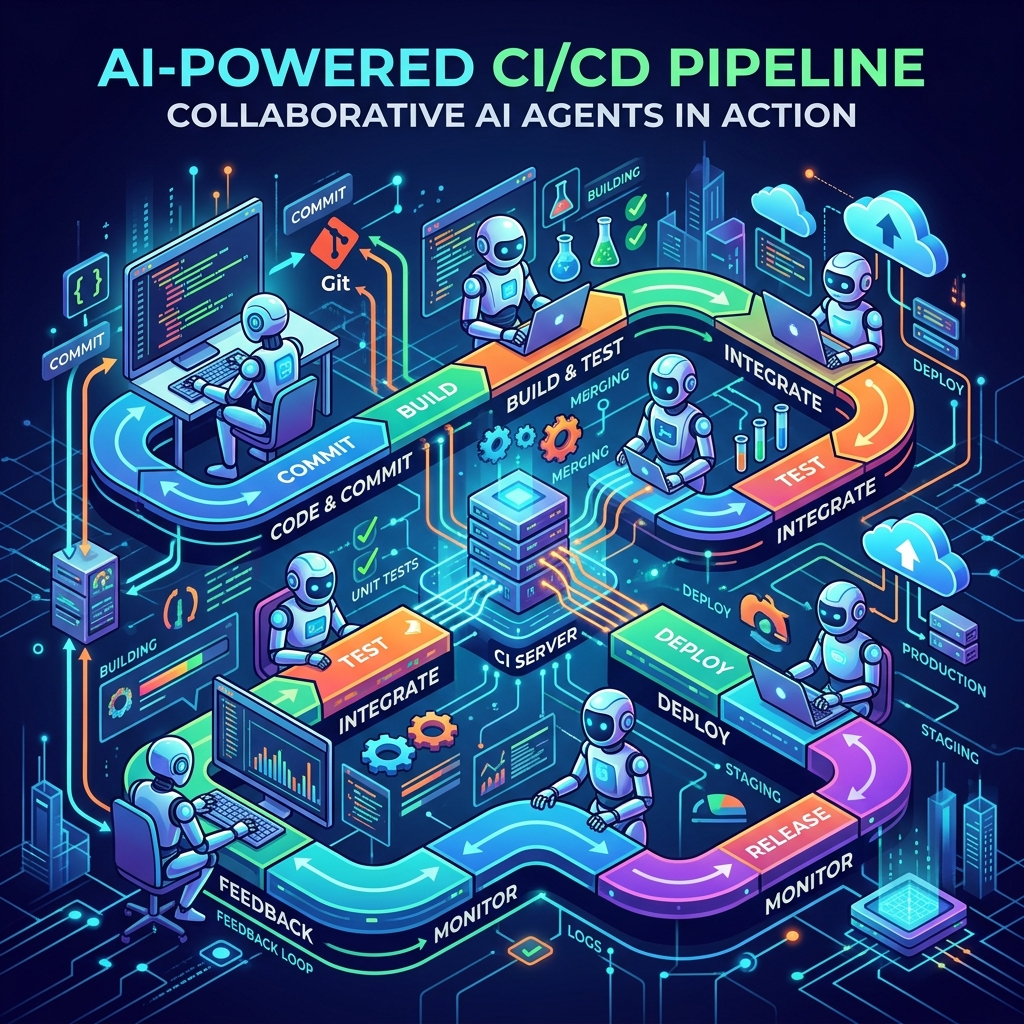
GitHub Actions (CI/CD orchestration)
    ↓
Claude Code (agentic code analysis & PR creation)
    ↓
GitHub Copilot (inline suggestions + PR reviews)
    ↓
Custom ESLint rules (convention enforcement)
    ↓
Vitest (100% coverage gate)
Workflow 1: Automated PR Creation via Agentic Skill
One of the highest-impact changes: having our AI assistant automatically create well-structured PRs from feature branches using a custom local skill/command, rather than manually writing descriptions or relying on post-push CI pipelines.
# We use a custom AI slash command directly in our agentic terminal:
/add-pr
When invoked, the agent automatically executes a predefined skill:
- Analyzes the git diff between the current branch and
main. - Generates a comprehensive PR description including:
- What changed and why
- How to test the changes
- Any breaking changes or migration notes
- Creates the pull request using the GitHub MCP server.
This "shifts left" the PR creation process, happening right in the developer's environment when the context is the freshest, rather than waiting for a CI runner.
Deep dive: I wrote a full article on building this skill, including the complete prompt, GitHub MCP setup, and pluggable extensions → Building an Agentic PR Generator: A Deep Dive
Time saved: ~20 minutes per PR × 3 PRs/week = 1 hour/engineer/week
Workflow 2: Architecture Convention Review
Instead of humans catching architectural violations in code review, Claude Code audits every PR against our documented conventions:
# In CI pipeline
- name: Architecture Review
  uses: anthropic-ai/claude-code-action@v1
  with:
    prompt: |
      Review the changed files against these conventions:

      REQUIRED:
      - Components must use named exports (not default exports)
      - 'use client' directive only when browser APIs are used
      - All resume data must come from lib/constants.ts
      - Every new component needs a corresponding test in __tests__/
      - No inline styles (style={{}})
      - TypeScript strict mode — no 'any' types

      Report violations in GitHub review comment format.
    files: ${{ steps.changed-files.outputs.all_changed_files }}
This catches conventions violations before human review even starts. Engineers spend their review time on logic and design decisions — not "you forgot to add a test."
Time saved: ~30 minutes per PR review = 1.5 hours/engineer/week
Workflow 3: Targeted Security & Performance Review
Not every change needs the same review depth. Claude categorizes changes and applies targeted reviews:
// The heuristic Claude uses:
const reviewLevel = {
  'lib/constants.ts': 'data-accuracy',
  'app/api/**': 'security-deep-dive',
  'components/**': 'accessibility + performance',
  '__tests__/**': 'coverage-completeness',
  '.github/workflows/**': 'security + secret-exposure',
}
For API routes, Claude specifically checks for:
- Unauthenticated endpoints
- SQL injection patterns
- Exposed secrets in response payloads
- Missing rate limiting
Time saved: Equivalent to ~1 senior review per sprint = 2 hours/engineer/week
Workflow 4: Automated Dependency Updates
The most tedious part of software maintenance is dependency updates. We fully automated this:
# Runs weekly
- name: Update dependencies with AI context
  run: |
    npx npm-check-updates -u
    npm install

- name: Validate with Claude
  uses: anthropic-ai/claude-code-action@v1
  with:
    prompt: |
      Review the package.json changes.
      Check each updated dependency for:
      1. Breaking API changes that affect our codebase
      2. Known security vulnerabilities in the old version
      3. Required code changes for the update

      Create a detailed migration PR description.
Time saved: ~45 minutes per dependency PR = 1.5 hours/engineer/week
The Numbers
After 2 months of running these workflows:
| Activity | Before | After | Saved |
|---|---|---|---|
| Writing PR descriptions | 20 min/PR | 2 min review | 18 min/PR |
| Catching convention violations | 15 min/review | 0 (automated) | 15 min/review |
| Dependency updates | 45 min/week | 5 min review | 40 min/week |
| Security review | 30 min/PR | Automated | 30 min/PR |
| Total | ~6 hrs/engineer/week |
The Key Insight
These tools don't replace engineers. They eliminate the mechanical, low-judgment work so engineers can focus on what they're actually good at: system design, creative problem-solving, and building relationships with stakeholders.
The best engineering teams of the next 5 years won't just write code faster — they'll build workflows where AI handles the repetitive scaffolding, and humans handle the decisions that matter.
Start with one workflow. Measure the time saved. Iterate.
Want to see the full workflow configurations? They're all in my portfolio repo. Drop a message on LinkedIn and I'll share the templates.

Himanshu Shrivastava
Senior Full Stack Engineer · Node.js · React · TypeScript · AWS · Accessibility