Stop Feeding Your LLM Raw Command Output: How RTK Cuts Tool Tokens by 60–90%
The Context Window Was Dying on git status
I already knew how to shrink agent replies. Caveman mode cut filler from what the model said. That helped — until I watched a single debugging loop chew through context on the other side of the pipe.
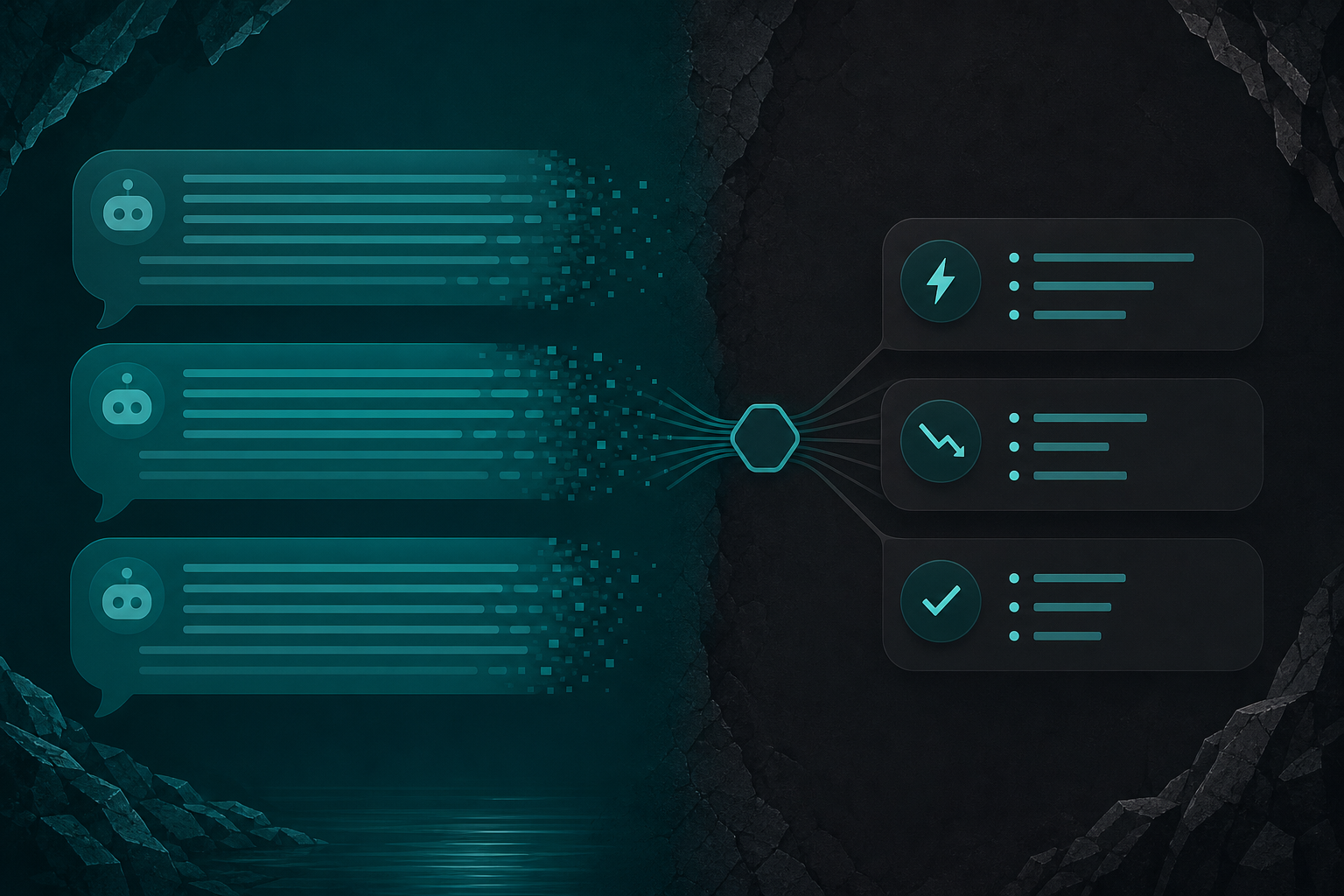
The agent ran git status, then git diff, then npm test. Each command returned the full, human-oriented dump: permission bits, progress bars, passing tests, “Enumerating objects…” — thousands of tokens of noise the model did not need to reason. By the time we hit the actual failure, half the window was landfill.
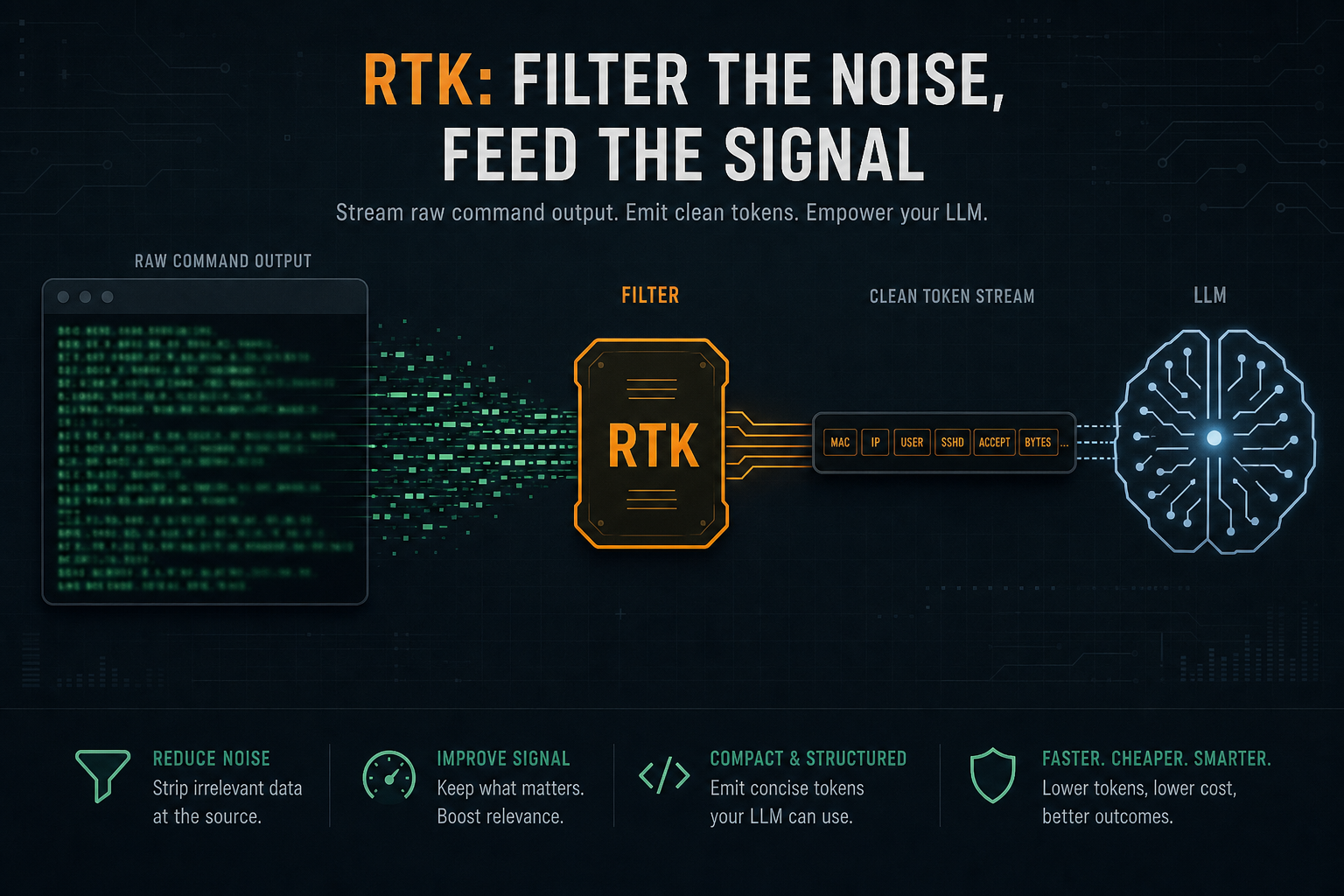
That is the problem RTK (Rust Token Killer) solves. It is a CLI proxy: same commands, filtered output, 60–90% fewer tokens on common tool calls — before anything reaches the LLM.
Caveman optimizes output tokens. RTK optimizes tool-output tokens. You want both.
What RTK Actually Does
RTK sits between the agent’s shell and the real binary. You (or a hook) run rtk git status instead of git status. RTK executes the real command, then applies four strategies per command family:
- Smart filtering — drop comments, whitespace noise, boilerplate banners
- Grouping — cluster files by directory, errors by type
- Truncation — keep the signal, cut redundancy
- Deduplication — collapse repeated log lines with counts
On a medium TypeScript/Rust project, their session estimate looks roughly like this:
| Operation | Standard | With RTK | Savings |
|---|---|---|---|
ls / tree | 2,000 | 400 | −80% |
git status | 3,000 | 600 | −80% |
git diff | 10,000 | 2,500 | −75% |
| test runners | 25,000 | 2,500 | −90% |
| Session total | ~118k | ~24k | ~−80% |
Those numbers match what I felt in practice: the agent still sees failures and changed files — it just stops rereading the same “ok” noise every turn.
Install Once, Wire to Your Agent
I use Homebrew on macOS:
brew install rtk
rtk --version   # expect something like rtk 0.28+
rtk gain        # empty until you start routing commands through it
Name collision warning: crates.io also has an unrelated “rtk” (Rust Type Kit). If rtk gain fails after a Cargo install, you grabbed the wrong package. Prefer Homebrew or cargo install --git https://github.com/rtk-ai/rtk.
Then point your agent at it:
# Claude Code / Copilot (default)
rtk init -g

# Cursor
rtk init -g --agent cursor

# Gemini CLI / Codex
rtk init -g --gemini
rtk init -g --codex
Restart the tool. Hook-based agents rewrite Bash calls transparently — git status becomes rtk git status before execution. The model gets compact output without changing how you prompt.
Gotcha that matters: on Claude Code, the hook only covers Bash tool calls. Built-in Read, Grep, and Glob bypass it. For those paths, either shell out (rg, cat) or call rtk read / rtk grep / rtk find explicitly.
The Commands That Paid Off First
I did not wrap everything on day one. I started with the three commands that dominate agent loops in my stack:
Git (status/diff/log) — compact status, condensed diffs, one-line logs. Mutating commands collapse to receipts like ok abc1234 instead of a 15-line push novel.
rtk git status
rtk git diff
rtk git log -n 10
# push/commit become short receipts: "ok main", "ok abc1234"
Tests (failures only) — Jest, Vitest, Playwright, pytest, cargo test, and a generic rtk test <cmd> wrapper. Passing suites shrink to near-nothing; failures stay readable.
rtk vitest
rtk playwright test
rtk test npm test   # generic: failures only (~−90%)
Lint / typecheck — ESLint grouped by rule/file, tsc errors grouped by file. The agent jumps to the cluster instead of scrolling a wall of identical rule names.
When a filtered command fails, RTK can tee the raw output to disk so the model can open the full log without re-running the suite — important for flaky CI debugging.
# ~/.config/rtk/config.toml (macOS: ~/Library/Application Support/rtk/)
[tee]
enabled = true
mode = "failures"   # "failures" | "always" | "never"

[hooks]
exclude_commands = ["curl", "playwright"]  # skip rewrite when you need raw output
How This Changed My Agent Workflow
On enterprise client work — React/Node streams with heavy test and lint loops — I treat RTK as platform plumbing, not a personal tip.
Before: agents spent turns re-digesting full git status and green test spam. Context filled with noise. I burned tokens (and patience) asking the same “what actually failed?” clarifying questions.
After: the default shell path is compressed. I keep deep-work prompts focused on decisions; the tooling stops flooding the window. Combined with reply compression (Caveman) and disciplined agent PR review, token spend becomes a stack:

| Layer | What it compresses | Tool |
|---|---|---|
| Agent speech | Output tokens / filler | Caveman (or similar) |
| Tool stdout | Command dumps into context | RTK |
| Human judgment | What merges / what ships | Review checklists, not more tokens |
I also run rtk gain and rtk discover weekly — same instinct as checking observability dashboards. If a high-frequency command shows 0% savings, it is either excluded or needs a filter. That is how you turn a shiny CLI into a durable DevEx default.
rtk gain              # summary
rtk gain --graph      # last 30 days
rtk discover --since 7
Key Takeaways
- Tool output is half the token bill. Shrinking replies without filtering
git/test/lsleaves the expensive half untouched. - RTK is a transparent proxy, not a new workflow language — hooks rewrite shell commands for Claude Code, Cursor, Gemini, Codex, and more.
- Start with git + tests + lint. Those dominate agent loops; 60–90% savings show up immediately.
- Know the hook boundary. Built-in Read/Grep/Glob may bypass rewrite — use shell or explicit
rtkcommands when you care. - Measure adoption.
rtk gain/rtk discoverturn token savings from a README claim into a weekly habit. - Pair with reply compression and strong review judgment — RTK saves context; it does not replace architecture or “should this merge?”
Raw command output was never designed for LLMs. Stop treating it like it was.

Himanshu Shrivastava
Senior Full Stack Engineer · Node.js · React · TypeScript · AWS · Accessibility